
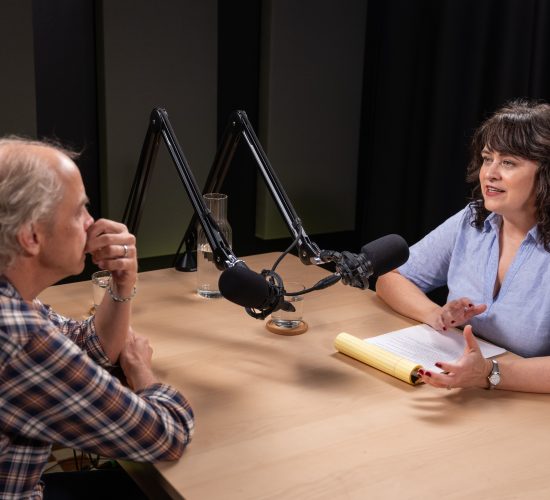
Listening bars have grown from fewer than 10 in the U.S. to more than 300 in about five years. Bart Stephens thinks he knows why. On this episode of The Localist, host Carrie Rollwagen talks with Bart, the owner of High Dive HiFi Lounge and Lakeview Marina in Birmingham’s Lakeview neighborhood.
Bart visited listening bars in Brooklyn, Miami, Japan, Berlin, Madrid, and Paris. Then he built his own. Along the way, a small building project turned into a half-block development with an outdoor music park, a record store, a barbershop, and a radio station.
Carrie and Bart talk about why listening bars are showing up now. Bart says High Dive doesn’t really sell coffee, food, or cocktails. It sells calm, stillness, and community. They also talk about how the Walkman and the algorithm made music private, and why people want to share it again.
Then they get practical. Bart explains how High Dive was built for sound. He shaped the room, cut noise from motors and machines, and used foam and Helmholtz resonators to soak up echoes. His biggest tip is simple: think about sound early. Fixing a loud room after you open costs more and does less. Bart says most restaurants find out they are too loud in opening week. By then, thin curtains on the wall are about all they can add.
Bart also shares how he picks tenants. He wants Lakeview Marina to feel like Birmingham, not anywhere. He talks about the mermaid, the Gulf Coast ideas behind the music park, and why he plays a long game.
Listening Bars: Topics Covered in This Episode
- How Lakeview Marina and High Dive grew up together
- Why listening bars went from fewer than 10 to more than 300 in the U.S.
- What listening bars around the world have in common
- Why High Dive sells calm, stillness, and community
- How the Walkman and the algorithm changed the way people share music
- How High Dive programs music all day, every day
- Why restaurants are so loud
- Quick acoustic wins: rugs, carpet, and ceiling tiles
- Why rectangular rooms are hard on sound
- Why it costs less to plan for sound early than to retrofit
- Mechanical noise and the noise floor
- Absorption, foam, and Helmholtz resonators
- Choosing local tenants over generic development
- Matching the neighborhood’s design language
- Gulf Coast design cues for the Lakeview Marina Music Park
- Building a business for the long term
Mentioned in This Episode
- High Dive HiFi Lounge
- Lakeview Marina Music Park
- Seasick Records
- Birmingham Classic Cuts
- Birmingham Mountain Radio
- The Garage
- Sloss Furnaces
- Pepper Place
- Rotary Trail
Follow Carrie Rollwagen
Connect with Bart Stephens
Bart Stephens owns High Dive HiFi Lounge, a listening lounge, coffee shop, and restaurant in Birmingham. He also owns Lakeview Marina, the Lakeview development that is home to High Dive, the Lakeview Marina Music Park, Seasick Records, Birmingham Classic Cuts, and Birmingham Mountain Radio.
Listen to The Localist on Spotify & Apple Podcasts
Thanks to Our Sponsor, Infomedia
The Localist is sponsored by Infomedia. They are a Birmingham-based web and digital marketing company. They help small businesses grow online.
Join Us at Localist Lab
Localist Lab is a free event series for small business owners. It meets on the third Thursday of most months at Saturn in Avondale. Free tacos and coffee too.
Subscribe to Carrie’s Newsletter
Want more small business tips from Carrie? Sign up for her newsletter.
FULL EPISODE TRANSCRIPT
Below is the full transcript of this episode of The Localist with Bart Stephens. This transcript is provided for accessibility and SEO.
_______________________________________
Carrie (00:11): Welcome to The Localist, a podcast for small businesses where we talk about the highs and lows of building community through entrepreneurship. I’m your host, author of “The Localist” book and small business consultant Carrie Rollwagen. The Localist is sponsored by Infomedia. Infomedia is a digital strategy company where I work as senior vice president. At Infomedia, we help small businesses get big results online.
Carrie: Our guest today is Bart Stephens. Bart is the owner of High Dive, which is a listening room in Lakeview. They have really good coffee, drinks, and food, but they also have this really intentional listening environment, so the sound is excellent quality. You’ll hear a lot of details today about how Bart and his team went about doing that. I really enjoyed that part of the conversation. We definitely get into nerding out over specifics, but I think that’s really good. Sound is something a lot of businesses don’t think about until the end, and one of the things Bart says today is that it’s more expensive to retrofit than it is to incorporate thinking about sound in the first place. So we’re really going to deep dive into that today.
Carrie: We’re also going to talk about Lakeview Marina. That’s the development where High Dive exists. It’s part of that development, but Lakeview Marina also includes an outdoor music venue, Seasick Records, Classic Cuts, and other businesses, including a new one we’re going to talk about on the podcast today. Bart is the owner of Lakeview Marina as well, so we get into a little bit about what it’s like to be the landlord and also own a business in the same space.
Carrie: You’re really going to hear today that Bart is very intentional and really thinks through everything he does, in life and in business. I enjoyed that perspective, because so often we feel like we have to move quickly and make whatever is the most expedient decision for our businesses. He reminds us that sometimes we can take the time to be thoughtful about it and get a really great product out of that. I enjoyed this conversation a lot, and I hope you do as well.
Carrie: Welcome to the podcast.
Bart: Thanks.
Carrie: This is fun, because you and I got to sit down at High Dive a few months ago and go through probably some of what we’re going to talk about today. Your story of how you opened these businesses is kind of unique, so I think the audience is going to really like it. Let’s start with what came first. Were you first interested in doing the listening room, or did you first want to develop Lakeview Marina as a concept, or did that all grow up together?
Bart (03:17): It all grew up together. It did start with me wanting to develop something downtown, and the idea of the listening lounge came after I was getting into that. But so did the scale of the whole thing. For years, I’d been fascinated with the renaissance of downtown and the repurposing of a lot of these old buildings. I was spending more and more time downtown, exploring back alleys. My wife is an architect, and we just love design, we love urban spaces, and we love discovering Birmingham.
Bart: So after years of that, and in the midst of COVID, I got a little more serious about trying to find an old building that I could do something with. I wasn’t entirely sure what that would even be. Maybe it would just be a crummy, cheap garage that we could buy and improve. That really was the original idea. But what happens is you start shopping and you find how impossible it is to actually find anything to buy, because a lot of people are looking at real estate downtown all the time. A lot of the stuff I was seeing was bigger than I had originally envisioned, and so the vision for the project naturally went toward, “Well, I could do this if I could lease out part of it.”
Carrie (05:05): Right.
Bart (05:06): And then you look at something else, and it’s, “Oh, I could do this if I leased out 80% of it.” It just got bigger that way. Then I started getting really taken by the idea, because I would see these spaces and imagine how cool they could be. The next thing I knew, I was assembling a couple of adjacent buildings. I was very fortunate to find a couple that were together. They were occupied, but by tenants that could happily be somewhere else. They didn’t really need to be downtown, so they were willing to sell and relocate. There were also two empty lots in there, so there was this opportunity to put these pieces of property together.
Bart: During that two-year process, in parallel and really totally separate, I was living this audiophile hobby, and learning about this really early-stage hospitality trend of listening bars. When I started learning about it, there were fewer than 10 in the country. This was about five years ago, and now there are over 300. So it’s definitely been a big trend. I was watching that, and the more I learned about listening bars, the more I would fantasize about how I would do it. And then I had this empty building right here, so the visions kind of merged.
Carrie (07:09): So tell me about that, because you experienced some listening rooms outside the country too, right? Is that when you first got into this?
Bart (07:18): I was kind of a midlife audiophile, I guess. I always had been into it, but I got into it more seriously in my mid to late 40s, really when my hearing started to get worse. Everybody’s telling you to turn down the TV or turn down the radio. Well, why is it turned up loud? Because I can’t hear it as well. And the other piece of that is that the clearer the music is, and the better the sound system is, the lower the volume needs to be to hear it clearly.
Bart: So I was getting into that hobby, and I learned about this trend. In the course of business travel, I had the opportunity to visit a couple in Brooklyn, and I loved it. It grabbed my curiosity. Then I sort of invented a reason to go to Miami and see another one, and got even more curious. So I started really making an effort to visit these places. If we went on vacation, I would have this ulterior motive to steer the trip toward somewhere with one of these spaces. Eventually that led to an opportunity to visit a bunch of them in Japan, where they started, and then in Europe: Berlin, Madrid, and Paris. And I continued to visit them in the U.S. as they were opening more and more frequently. That was an incredible experience.
Carrie (09:16): What did you learn? Did it all meld together, or are there things you loved that you were able to bring back?
Bart (09:31): The words around this are kind of unsettled: listening lounges, hi-fi bars, listening spaces, whatever. The more I visited, there were two things I would observe. Of course, there’s a cluster that sort of copy each other and follow a standard playbook. You’ll take a 45-minute Uber across Boston, walk in, and in five minutes you’re like, “OK, I get what this is. Somebody threw a turntable at the end of the bar, and that’s all this is.”
Bart: But the more interesting thing I observed is that the more of these you go to, the thinner the line connecting all of them gets. People have an idea of what these listening lounges are. Then you go to a second one, and it’s very different. You go to a third one, and that’s very different too. This one is a dark cocktail bar. This other one closes at 5 o’clock every day and doesn’t even serve alcohol; it’s more of a coffee shop. Then there’s one that’s a romantic speakeasy, and one that’s a larger college bar. As I saw more diverse examples of what these places could be, it got more challenging to figure out what they actually have in common. What actually defines these spaces?
Bart: They’re typically bars, and they often have food. Usually they’re somewhere in between a bar and a restaurant, so start there. This shouldn’t be a crazy esoteric thing. In real-world language, these are bars and restaurants that have done something to put music at the center of the hospitality or guest experience. But if you’re a bar or restaurant that puts music at the center, you could also be a dance club or a music venue, and these are not that. They’re different from music venues or jazz clubs because they’re not focused on live music. Generally, they’re focused on playing back recorded music. But so are dance clubs. I think the main distinction between these spaces and dance clubs is that people are seated. That seems so basic, but that’s really it. If you went to a lot of clubs that have great sound systems and acoustic treatments, where music is at the center of the experience, and you filled up the dance floor with lounge seating, that’s what a lot of these places are.
Bart (13:09): But from the beginning, what always captured my imagination is: What is this anthropologically, and what is this sociologically? Why now? I get what it is, and anybody you explain it to immediately says, “Oh, that sounds great.” But why now? Why in 2020, in the West, in the United States, in Europe? There’s no reason this couldn’t have taken root in 2010 or 2000 or 1990 or 1980 or 1970, but it truly didn’t. You would have restaurants or bars with a jukebox, maybe, but a hi-fi sound system, a big collection of records on the wall, and an acoustically treated space? You just didn’t see that prior to 2020. Meanwhile, it’s been in Japan since before World War II. So why? I’m still fascinated by it.
Carrie (14:24): Well, I would guess a couple of things. One is how disconnected we are, and how we’re looking for human experience again. And I don’t know if this is even accurate, but I feel like as technology has made playing music more and more accessible, it’s sounded worse in some ways. If you’re listening to music on your phone, and I’m probably not using the right terms, it’s pretty tinny and it doesn’t sound good, and that’s how a lot of us are listening. It is a very different experience to go to High Dive. It’s just more calming, if that makes sense.
Bart (15:11): It makes perfect sense, and I hope that’s true. I’ve used that exact word. I’ve told people I don’t think we’re selling coffee and food and cocktails and music here. I think we’re selling calmness, stillness, and community. And the reason that’s driving this trend nationally is that, sadly, there’s an increasing premium on those things.
Bart (15:47): My answer to why now is that this is, I don’t want to call it a backlash, but it’s a reaction to the internet and to social media. In the decades ahead, I think anthropologists are going to find hundreds of ways that the world changed as a result of being connected, and this is just a very small one. But I do think that’s what’s driving it. We are all going into this future that we didn’t ask for, and there’s no real choice about that. We are all on our phones, and that’s the way the world is. But part of evolving in that direction is going to be figuring out how to balance it: more time in nature, more time trying to do one thing at a time. Read a book. Connect personally with a neighbor or a stranger or a friend, in the place where you live, in real time. That strange thing of talking to another human being. That’s going to help keep us in touch with our humanity and recharge us a little bit, because then we have to walk out the door and go back to the world the way it normally is.
Carrie (17:27): Music, too, was originally more of a communal experience, and now so many of us experience music just through AirPods. It’s the antithesis of a communal experience. A listening room brings you back to that. Going to see live music would do the same. Culturally, we used to do that more. Even things like church involve singing, but that’s not a typical experience anymore.
Bart (18:04): 100%. Music is just one art form, but it’s maybe the most popular and the most accessible to a lot of people. As you say that, it reminds me of an anecdote about when Sony introduced the Walkman, in the very early ’80s, I think. There was concern within Sony that it would be considered rude to be in public with headphones on, listening to music privately. So they actually had a button on top you could press to activate a second headphone output. The idea was that you and your date could walk around with wired headphones. Of course, that quickly went away, but that was maybe the first step in taking music from a social, communal experience to a more private one.
Bart: The more recent step is more troubling. At least in the ’80s, you were listening to a Prince record or whatever. This sounds crazy to say, but you were listening to a product that had been curated by record companies, radio, music magazines, and journalism, and so was a lot of the rest of the world. You might be listening privately on headphones, but you were listening to what’s popular, and you were all sharing in it. What’s happened in the last 10 years especially is that the algorithm has broken that apart. Now, not only are we listening on headphones, but we’re all listening to completely different, individualized algorithms. To me, that’s the real heartbreaking loss: We’re not sharing these exciting cultural moments created by popular music. There’s no Beatles-on-Ed-Sullivan moment anymore. Somebody said a couple of years ago that Taylor Swift’s Eras Tour was the first example of real monoculture in a while. I’ve got a high school daughter, and we definitely had a lot of exposure to that, and I think that’s right. It was great. It’s so cool that fans around the country and around the world could get excited about that together. That’s fun.
Carrie (20:57): I like describing it as fun, because that’s part of it, and it does seem like the listening lounge can capture a little bit of that. It’s not a global phenomenon in the same way, but it’s still people enjoying the same music together, which is worthwhile.
Bart (21:20): 100%.
Carrie (21:21): Has that impacted the way you program music? Is it harder when everybody likes something different? Has it been interesting to say, “OK, this is a niche we want to attract,” or “This is something we want to share with people”? How does that affect your programming?
Bart (21:42): That’s an interesting question. Programming requires endless energy and attention, because if you pick great music for eight hours this evening, you get to wake up and do it again tomorrow, and the next day, and the next day, forever. It’s a little bit like a radio station. Even if we don’t have anybody in the room, we still need to do it, and it’s demanding. That’s definitely something I’ve taken away. Like a radio station, we’re trying to walk the line between playing music that is familiar, enjoyable, and appropriate to the moment, the day, and the time of day, and music that’s interesting, not repetitive, and fresh, with some discovery. How to program it is a constant subject for us.
Bart: You gave the live music example, and I think people do want experiences where they’re connected to the people around them and to community. It’s probably why you go to a live sporting event rather than just watch it on TV. It’s the same game, but you experience it differently. It’s great to be in the lounge when a certain song comes on. We’ll turn up the volume a little bit, and you can see people’s feet tapping and heads nodding. They’re reacting together, and it creates that intangible vibe you’re just not going to get listening to that song in your car alone.
Bart: The other interesting aspect is to compare this to other restaurants, where the food’s great, the furniture’s great, the lighting’s great, the design’s great, the service is great, the beverages are great, and things smell good, but sound has just been neglected completely. You’re in this experiential thing of hospitality and dining, and there’s one very important sensory element that’s been neglected. So don’t just compare the lounge to listening to music in your car. Compare it to eating at a restaurant that doesn’t have any music, or that’s so loud you can’t talk.
Carrie (24:48): Or where voices are so loud because nobody has specifically worked on that, and it gets very difficult.
Bart (24:57): Restaurants are loud. Going back to when this trend emerged and the articles about it, there was a strain of the conversation about music and culture and connection, and there was a strain of the conversation that was just, “Restaurants are loud.”
Carrie (25:15): I think it’s interesting that you talked about a little bit of hearing loss being part of this, because I hear different pitches. I can usually hear when a device is charged, that ringing sound, and it makes sensory environments difficult because there’s a lot going on. I wouldn’t be able to tell you, when I’m sitting in High Dive, why it feels different. But there are so many people who wouldn’t consider themselves audiophiles, and wouldn’t necessarily know why they’d seek out High Dive, who would feel that calm. Maybe you hear different pitches, or maybe there’s hearing loss, or maybe certain things really irritate you. We forget about that sense in some ways. Our world is really loud, and we forget how much that impacts us.
Bart (26:22): Yeah, and I don’t think you need to be an audiophile to appreciate that at all. You maybe have to be an audiophile to go build one of these places. But everybody is affected by good lighting or bad lighting. Everybody appreciates a place that’s well designed, and I think anyone would appreciate a better sonic environment. It’s just not a priority in our culture. I don’t want to get in trouble with any architects, but I don’t know that it’s really been a huge priority in architecture and design, so it’s easy to neglect it and forget about it. And I think there are a lot of myths that you can’t do anything about it. That was a motivation behind High Dive as well. I wanted to see if that was true.
Carrie (27:28): Tell us about that process. What was it like building it out? I don’t know if I’m mischaracterizing this, but last time we talked, I think you said you meant it to be more of a dive bar, but when it came to the build-out, you had to do high-end stuff. What did you discover through that process?
Bart (27:51): I did love that. It was such an opportunity to go down a rabbit hole and become a student of something, which I’m really thankful for. It was asking questions, learning, getting introduced to other people, asking other questions, hearing a lot of opinions, going and seeing places and listening, and forming your own opinion about the endless stream of trade-offs. What’s the cost-benefit? What’s the bang for the buck of this strategy versus that strategy, or this tactic versus that tactic? Once you start learning about it, you start seeing it everywhere. I was always thinking about it and talking about it. When we’d go out to eat, I’d have fun with my kids and say, “OK, who can name three things in this room that are affecting the way this room sounds?” And they’d be very quick: “Well, that ceiling, and the rug, and …”
Carrie (29:09): What are some things you see that would be pretty quick wins? Is it incorporating more texture or fabric?
Bart (29:20): There are two things I see in this studio right now that you see in a lot of environments: carpet and rugs. That’s very difficult in a food and beverage environment, but it’s huge. It’s a big step. And then the acoustical tile ceiling you see in most office spaces is another big step. Those are easy wins.
Bart: I don’t know how far down this rabbit hole you want to go, but 99.9% of the spaces we’re in are rectangular boxes, and unfortunately that’s not a good place to start. First off, just being inside, you’re already at a disadvantage, because sound starts to bounce and echo. A perfect acoustic environment is a flat field with nothing behind you that just goes on forever. Put people indoors, and you have to start dealing with that immediately. If the walls are parallel, echoes bounce back and forth in an organized, consistent way that, psychoacoustically, you can hear, and that’s not good. So theaters and a lot of acoustic spaces will have surfaces that are not parallel.
Bart (31:12): The sound still bounces, but the more it bounces, the more disorganized it gets, and it doesn’t compete with what you’re really trying to hear, which is what’s coming out of the speakers. We did a little work on that, on the shaping of the room. We started by doing some calculations with an acoustician about the size and the shape of the room. Mathematically, you can determine very quickly which frequencies are going to be problematic, which ones are going to bounce back and forth and, as a result, either double the volume of that frequency or cut it in half. There’s a lot of science behind it that’s hard to verbalize, but we started there.
Bart: Backing up, there’s another principle: When it comes to a space like this, the earlier in the process you start thinking about sound, the more impact you can make for less money.
Carrie (32:21): That makes total sense, because if you design without thinking about it, you can’t really retrofit.
Bart (32:30): That’s what most restaurants do. They have their opening week, they’re very busy, there’s a lot of energy, everybody loves it, and it’s very, very loud. At that point, the restaurant’s built. What do they do? They go hang some thin curtains on the wall or put something under the tables, and that’s expensive, with a very marginal impact. Unless you’re going to start tearing things apart, there’s very little you can do after it’s built.
Bart (33:02): We considered everything we possibly could. It’s always a trade-off between investment and impact, so we didn’t do everything, but we considered everything, and we did what we thought would have a return. The shape of the room was one thing. And very early on, I was pretty dogmatic about mechanical noise: the noise of refrigerators and air conditioning units. It basically comes down to motors and machines.
Carrie (33:39): That’s probably why it’s calming for me, because I can usually hear that stuff.
Bart (33:45): That means you have good high-end hearing, which is the first to go for a lot of people. But I don’t like that stuff either. I think it’s a subconscious tax on our energy to constantly hear that white noise. The other thing it does is that the quietest sound you want to hear, like somebody’s voice in a conversation or music played over a loudspeaker, has to be louder than the ambient noise in the room. So the lower you can drop that noise floor, the lower you can play music. Mechanical noise was a big deal for us.
Bart (34:24): I mentioned the room shape. Without going into every little detail, a lot of what we did came down to absorption: finding the frequencies in that room where reverberation was going to be most problematic, and absorbing them into the walls or the ceiling with absorptive materials. The pink fuzzy insulation in our walls at home is a perfect example of that. But in our case, we were very intentional and scientific about it. Our walls and ceiling have multiple densities of foam, strategically placed in different areas, and things called Helmholtz resonators, which absorb lower frequencies in less space.
Bart: All of that is to absorb sound, and when I say sound, I mean music, but also conversation and restaurant noise. You absorb that sound after it’s passed your ears, so it doesn’t have a chance to bounce off a wall and echo back, so you hear it again milliseconds later. That’s a first reflection. Or it bounces a second time and comes back past your ear a few milliseconds after that: a second reflection, or a third or fourth, which is typically what you hear in an untreated room. You clap your hands, and you hear the four echoes of that.
Carrie (36:19): Right.
Bart (36:20): So you get rid of all those echoes, and the hand clap is much clearer. Those were the main moves. You do all of that, and you’re left with a room that should sound good to talk in, like this podcast studio. We can speak quietly and hear each other clearly, and acoustic instruments should sound fantastic. Now, if you want to play a record, or talk through a microphone, you get into a completely different subject, which is: Now that we have this great acoustic room, how do we design a sound system for the space?
Carrie (37:10): There’s a ton of intentionality in everything you’re doing with High Dive, and also an emphasis on community, and I think that applies not only to High Dive but to Lakeview Marina overall. And I said Lake Shore Marina at first. I’ve had enough coffee; I should know that. It’s in Lakeview. There’s a Lake Shore Drive, but they don’t have a marina, either. I’ve looked into it at some point. There’s a creek over there that I think used to extend. Obviously, my attention to detail is not there today.
Carrie: We also talked about how a lot of people who buy property just work with developers who say, “Here are some people with money,” who are probably coming in from out of state, and they just put in whoever. I think you’ve done the opposite, being very intentional. I think Daniel and Seasick were first, or maybe not the first, but Seasick and Classic Cuts are very connected to music in Birmingham and pretty intentional about the space. And then Birmingham Mountain Radio is moving in, right?
Bart (38:51): They moved in two days ago.
Carrie (38:51): Oh, OK. So when people are listening, they’ll be there. How have you approached that? Has that been difficult, or have you enjoyed curating it?
Bart (39:06): Yes, and, intentional or lucky, I don’t know. The intentional part, from the beginning, was that as I was looking at real estate downtown and watching this renaissance of downtown over the past 25 years, I saw a mix of things. There are truly homegrown makers and entrepreneurs and people doing things independently in downtown Birmingham. You’ve been a part of a few of those, and your podcast, The Localist, does a great job of identifying those things. Then we see growth that’s kind of generic: some chain or franchise or out-of-town developer that’s investing in a building. That’s good. We want to see the growth. But when I’m standing in that building or shop or restaurant or on that sidewalk, I could be anywhere. There’s nothing about it that says Birmingham to me.
Bart: An example I will beat up on, and I hope I don’t hurt anybody’s feelings, is the design language of modern urban apartment complexes. I’ve heard them described as four-over-one buildings: five-story apartment complexes with retail on the bottom floor and four stories above. We’ve had 10 of them come up on the Southside of Birmingham in the last 10 years. You love the density of people living there, but design-wise, they’re blah. If you go online and look at Winston-Salem and Sacramento and Evanston, Illinois, it’s the same building.
Bart (41:19): You can tell somebody flattened the land and some 3D printer in a spaceship came and plopped the thing down, compared to some of the beautiful old brick buildings we have in Birmingham. So I was sensitive to that. As a citizen and a consumer, I responded to and enjoyed places that truly felt local, that felt like, “Ah, this is Birmingham.” On that side of the ledger, we’ve had the breweries and the ballpark, and Daniel Drinkard. Seasick Records is a perfect example of a very independent local company. There are a lot of them: Parkside, and The Garage, which is something I always associate with old Birmingham and love dearly. The restaurants the Stitts have done. Pepper Place. We have wonderful, original, independent things here in the city, and that was the vein I wanted to go down.
Carrie (42:40): I like that, especially in the area where you are. There’s a lot of stuff that’s been there a long time, but you’re carving out an individuality in the look, not only the interiors but also the outdoor space and how you’ve designed the outside. Nobody would have necessarily expected it right there, but it seems like you’re creating something new and unique.
Bart (43:09): Thank you. Being real, I don’t think any of the buildings at Lakeview Marina are architectural gems. You’ve got some one-story metal buildings and cinderblock buildings that weren’t that special. They’re in what’s referred to as the automotive neighborhood of Lakeview. There were a lot of old auto mechanic shops there back in the day, and there are still a few. When we started the renovation with ArchitectureWorks and then with CCR Architecture, we looked around the neighborhood, four or five blocks in all directions, and tried to understand the existing architectural language of the old buildings. Sometimes this stuff is very humble, like the nature of a metal awning over a doorway. But we wanted to fit that and match that. We wanted to honor the sense of place we were in.
Bart: With the landscape architecture, we looked at the Rotary Trail and Red Mountain and said we need to pull in this emerging language of landscape and planting that’s becoming the look of downtown Birmingham. The rock and gravel we used, we made sure it was red rock with iron content. To me, that’s the look of Sloss Furnaces downtown. We did want it to feel like you were in Birmingham. That was very important. But once we felt comfortable that we were there, we didn’t want to be contrived about it. We weren’t trying to create a fake sense that it was 1945. It’s new. It’s a renovation. As much as I would love for it to look like The Garage, which is my favorite place in town, you can’t build that. You have to earn that over decades.
Bart: So we tried to be as creative and as fun as we could with the newer elements, and the marina thing is kind of fun. We try not to overdo it and make it obnoxious, but it’s a subtle wink and a nod to the absurdity of the neighborhood being called Lakeview to begin with. Everybody wants to tell me there was a lake. I know there was a lake. But there is not a lake now, and there is not a view, and it’s in downtown Birmingham. So, OK, we’ll put a marina there.
Carrie (46:17): I do like that. And you’ve incorporated, is it a mermaid or a siren?
Bart (46:23): We’ve got a mermaid. And some things happen that are totally unintentional but kind of fun. Seasick, our first tenant, has this nautical name, and that happened independently. Then we were naming High Dive, and we knew it was connected, but that’s really not why we chose it. We said, “OK, we’re going to do this, but we’re not going to put pirates and crab nets everywhere. Let’s stay under control.” I don’t want to reveal too much, but this episode is coming out in a month or so, and by then we should have a little pop-up fashion boutique in there, next to Birmingham Mountain Radio. It’s called Blonde on Blonde Surf Company. So now we have another nautical tenant.
Carrie (47:19): You’re also playing with it so it’s not too matchy-matchy. It’s all aquatic, but not in the same genre. High Dive is different from Seasick, and a surf company is different from both. They’re all in a different zone.
Bart (47:37): My dream for how that evolves is that one day, when it’s all built out, a visitor could come and experience the whole thing, and then say, “Wait. Surf, High Dive, Seasick. Did they mean to do that? It doesn’t look like they meant to do that.”
Carrie (48:00): It’s connected subconsciously, but not on such a conscious level.
Bart (48:07): I’ll take it one step further, since we’re showing our cards and telling all our secrets today. A lot of the design cues for what we call the music park, the Lakeview Marina Music Park, which combines very boring descriptive language with creative things like Lakeview Marina, were taken from the Gulf Coast. When you go down to the Panhandle, whether it’s Gulf Shores or 30A, with Blue Mountain Beach, Seagrove, Grayton, Alys Beach, and Rosemary Beach, basically the part of the Gulf that’s the shortest drive from Birmingham, that’s one of the places you see this outdoor hospitality concept really emerge and mature beyond what it is in Birmingham. You see it a lot of places around the country, like New Orleans or Portland, Oregon. I think it’s gone further, faster there than it has in Birmingham. These outdoor hospitality parks have Astroturf, football on a screen, Adirondack chairs, a stage, and food trucks. There’s a lot of that down at the beach, and if the weather’s good, it’s fantastic. It’s better than going to a restaurant.
Bart (49:48): People have choices, and it’s relaxing. So that was definitely a reference for us when we designed the park. With the food trucks, we knew early on we wanted to try to use Airstreams, which looked to me like little land yachts or little boats, and that fed the marina idea as well. If we can get that really going, it should be Birmingham’s first food truck park. We’ve got a little more work to do, but it’s coming.
Carrie (50:30): I think that’s exciting, and I love hearing you talk about all this, because that intentionality does shine through when you’re there, even if you don’t quote-unquote get all of it. Now that you mention the Gulf Coast references, I can see them, but I didn’t walk in thinking, “Oh, this is like the beach.” So often, that’s not how we approach business. We don’t have the time, or we don’t take the time. Often it’s just, “Here’s what’s going to make a profit, so we have to do that.” It sounds like you are focused on profit, but you’re also saying, “If I’m doing this, I want to do it in a way that’s worthwhile and adds something to the community.”
Bart (51:26): Very much so. There’s definitely an ethos and an element to this that’s longer term than a simple real estate investment you might make in Tucson, Arizona, where you’re never going to visit and you’re just putting money into something. It’s very personal to me. I love Birmingham. We wanted to create a space we’d enjoy. And I have faith that if the product is right, and the customers are treated well, and the employees are treated well, the owners’ concerns will be taken care of in time. But first is the customer and the employee. Then you have the opportunity to build a business that not only works but is truly sustainable over a long period of time. It may not be the strategy for the quickest return, but I think it’s the right strategy for building something lasting, which is what I hope to do.
Carrie (52:49): Well, people do seem to be getting it and enjoying it. I hear a lot about it, and I enjoy going. For people listening, what’s the best way to experience it? I’m guessing it’s just to come by. Should they follow you on social media to find out what’s going on, or just drop by?
Bart (53:15): Do all the things. I would step back and say that Lakeview Marina, in its essence, is a mixed-use real estate development. We don’t really expect to have a big consumer-facing marketing message for the development itself. It’s the tenants and the brands within it that are going to be speaking to customers. So High Dive, of course, has its webpage and its email list and its social media channels, as does Seasick, as does Birmingham Classic Cuts, as does Birmingham Mountain Radio.
Carrie (54:04): And the more you get involved with whichever one is your favorite, the more crossover you see. Following any of you on social, you’ll have someone from Classic Cuts come in and DJ, or Dan will be doing something you’re promoting. You’ve chosen well, and it seems like you all do stuff together.
Bart (54:26): I feel like in this world, where music has been consolidated by international corporations and a lot of what we’re being served is programmed or controlled by people who are not from here, there’s hopefully some power in cooperating with other like-minded, independent cultural producers here in town. There’s been a lot of luck in pulling those partners together. I think we’re all wildcats on some level. We’re all independent folks. So how well do we all work together? That’s going to be the real world. But the intention is definitely there.
Bart: Whether you’re a local member of the community, or a band or act that’s performing there, you can come and have access to a great music venue with two different stages, a great listening lounge, an excellent independent radio station, and one of the best independent record stores in the country, all within 100 yards of each other, surrounded by great food, great drinks, and a great physical space. That’s a formula for something. It should be a great place to hang out. As far as your question of how people engage, I’d say come down there. It’s a physical space. It’s designed to be experienced in person, in real time, not on your phone. Check your phone, see what we’re doing, but come down, walk around, have a meal, go to a show, and shop. It’s going to get better and better as we get more tenants and more people down there.
Carrie (56:43): Well, thank you so much. I appreciate it. I’m excited that we got to share this with the listeners.
Bart (56:49): I am too. I really appreciate the opportunity.
Carrie (56:51): The Localist is written and produced by me, Carrie Rollwagen. Our showrunner is Taylor Davis. Our outreach manager is B.J. Eadie, and our producer with us in the room today is Paul Bryant. We’re sponsored by Infomedia, and I want to thank Infomedia again for sponsoring the show and making everything we do here possible. So until next time, whether you’re buying from a local business or running one, thanks for all you do to make our community stronger every day.